

Lambert

Hogenhout

Thought Leader | Author | Speaker

Who I am

Thought leader, author, keynote speaker on technology in society

I am Chief of Section working on Data and AI at the United Nations Secretariat. I have published several books (fiction and non-fiction) and I am a keynote speaker and advisor on AI strategy and the responsible use of technology.

Interests

What's on my mind?

I believe AI will fundamentally alter our world. Practically, I focus on AI Governance and Strategy for public and private organizations. I also study the medium-term Societal Impact of emerging technologies.


I am an advocate for Digital Ethics, which includes Trustworthy AI and the Responsible use of technology in general.


I a curious how AI will influence how we think about Data and the implications for Data Privacy.


I am fascinated by how new technologies can support decision making in organizations.

I enjoy seeing how innovative Games explore new ways to engage us, make us think and interact.

Activities

What am I working on?
Tech

Working on governance and tools for data readiness for AI.


Implementing programs for AI Literacy for UN staff.

Writing

A new script for a short movie (which of course involves AI!)

Events

--

My Publications

Research

Protecting Persona Biometric Data: The Case of Facial Privacy

Together with Rinzin Wangmo. The paper introduces the concept of facial privacy explores to what extent facial data is covered under existing data privacy regulations, and proposes policy that could help protext citizens from unwanted use of facial recognition for commercial or surveillance purposes.


Youth and AI

Together with Prof. Toshie Takahasi, we worked with 250 young people from 36 countries to understand their views on AI - their hopes, fears and questions. The final report shows general enthusiasm about AI, although unemployment is a fear in many parts of the world.


Ethical AI

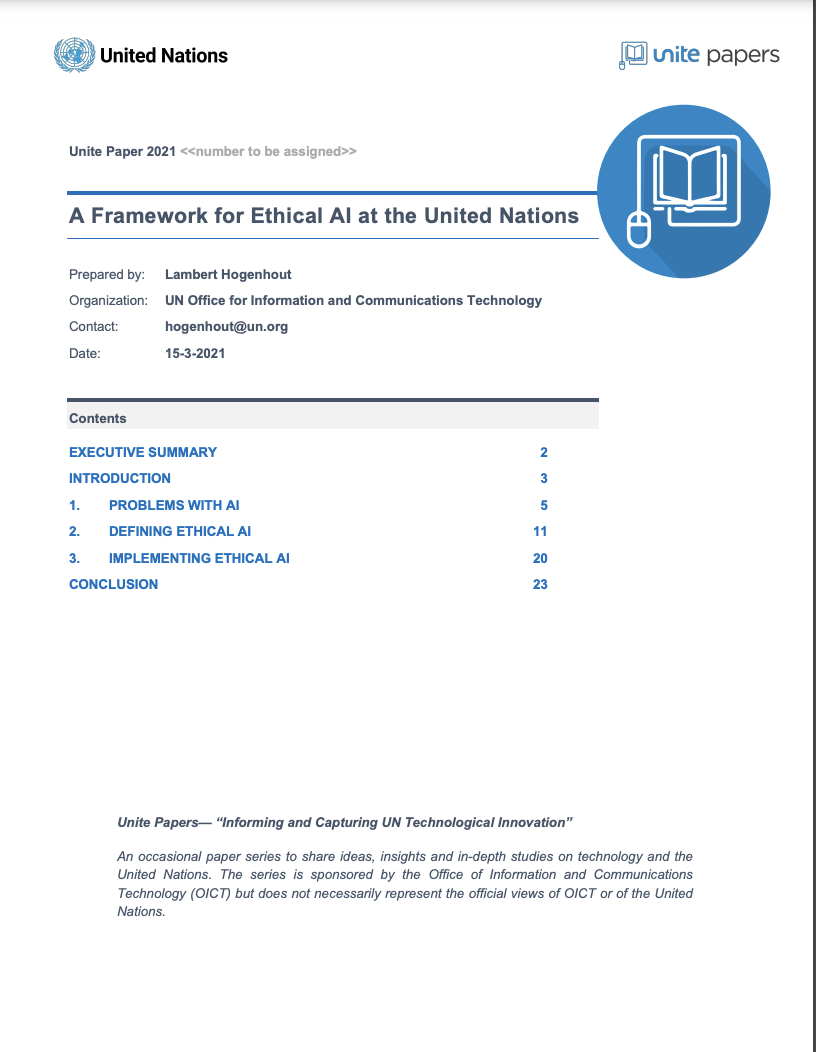
A few years ago, I wrote an article that discusses an Ethical Framework for AI at the UN. This contributed to what eventually became the UN's Principles for the Ethical use of AI which were adopted in October 2022.

Non-fiction

Data Privacy

Together with Amanda Wang, I wrote Data Privacy across Borders to help organizations that operate globally to develop an approach for Data Privacy. It advocates shifting from a compliance driven mindset to using Data Privacy as a strategic differentiator.

Fiction

Seven Short Stories

Life is not always easy. In these stories we get to know 7 different individuals: their dreams the challenges they face and the choices they make. What role do fame, courage, hatred, respect, hope and sincerity play? Are they making life easier or more complicated?
The short stories can be enjoyed individually, but they also fit together like pieces of a puzzle — a truly unique book.


Dancing on the Equator

A crime novel set on board of the Normandie, a luxury cruise ship, traveling from New York to Rio de Janeiro. It is early 1939 and tensions are high in Europe, but the passengers onboard the Normandie are living it up. Yet not all is as it seems.
(Out of Print)


My Meditations

Seneca knew about data privacy. He just didn't have the words for it.

By: Lambert March 2026

Writing in 49 AD, he observed something that still stings: we guard our money, our houses, our possessions with fierce vigilance. We lose sleep over them. We build walls around them. But our time? Our attention? Those we give away freely — often without realising it.
"People are frugal in guarding their personal property," he wrote, "but as soon as it comes to squandering time, they are most wasteful."

Even though data privacy was not yet on top of people's mind in the first century AD, I feel that his words apply perfectly to today's world with facial recognition and data privacy concerns. The asymmetry is striking. Most of us would never hand a stranger a key to our home. Yet we share photos every day that feed systems we don't understand, building a map of our face that we can never take back.

This is exactly why we built reFaced, a free app that lets you subtly modify photos to protect your facial identity before sharing them online. The change is invisible to the human eye. It's not invisible to facial recognition systems. Coming soon for iOS and Android. See more at facialprivacy.com

Your face is yours. It always was.

Facial Privacy is a Human rightly
We are not all living in the same year

By: Lambert March 2026

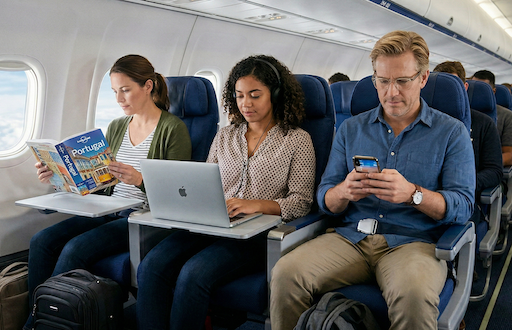
On the plane to the Algarve last week, three passengers sat in the same row — and in three different decades. I am not talked about our ages, which were about the same.

The woman by the window had a physical guidebook open on her lap. The woman in the middle was scrolling Tripadvisor reviews. And I had a .md file on my phone — a schedule, routes, and restaurant recommendations generated by Claude Cowork.

Same destination. Same moment. Three completely different relationships with knowledge.

We talk about technological change as if it sweeps everyone forward together — like a tide that raises all boats simultaneously. But it doesn't work that way. Change is a layering. New tools arrive and sit on top of older ones, and people move between those layers based on habit, preference, age, trust, circumstance — or simply because one approach works well enough that there's no reason to abandon it.

The guidebook woman wasn't behind. She had something I didn't: the distilled judgment of a single expert, curated and edited, free from algorithmic noise. The Tripadvisor woman had recency and scale — thousands of real opinions, updated last week. I had speed and personalisation, provided by an AI.

There's a philosophical question buried in all of this that I find genuinely interesting: when does a tool shape the person using it, rather than the other way around? The guidebook reader navigates with a different quality of attention than the person scanning a feed. The AI-assisted traveller may arrive knowing more facts and fewer stories.

I don't think any of us was wrong. But I do think the choice deserves to be a choice — conscious and deliberate — rather than something that simply happens to you as defaults accumulate.

In a world with this many layers, the most useful skill may not be knowing which tool is best. It may be knowing yourself well enough to choose.

What tool do you reach for first, and do you remember deciding to?

people sitting in an airplane

the image is generated with AI for privacy reasons, but closely resembling the actual scene.

Product Review: The Remington Portable

By: Lambert March 2026

When the Remington Portable came out in the 1920s, it was the top of the line and a marvel of engineering. If you were a journalist who was often on the road, or a writer planning to spend some time in Paris, you'd take a Remington Portable with you.

F. Scott Fitzgerald and Agatha Christie have used one to write some of their most famous works. Margaret Mitchell typed Gone with the Wind on a Remington Portable. Bill Heinz, a sports writer and World War II correspondent, carried a Remington Portable No. 3 in the field. Hemingway is also often mentioned in connection with it, but I have found no evidence that he used one.

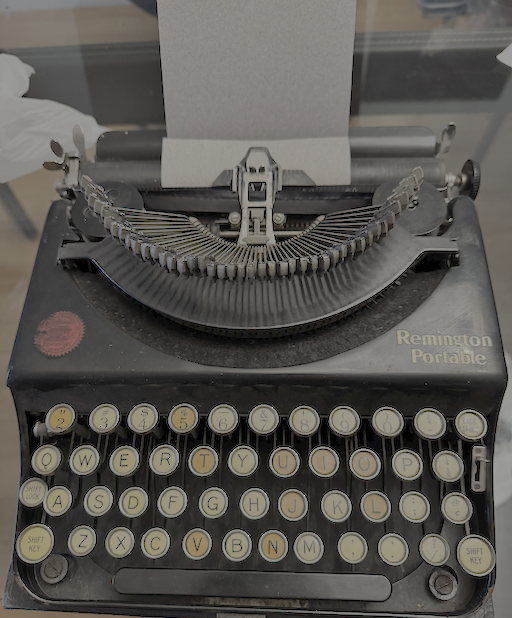
My own Remington Portable no. 2 has serial number NX26311, which was produced in March 1926, so it is celebrating its 100th birthday this month!

The Remington engineers solved a hard problem: how to fit a full-sized keyboard and standard-width carriage into a case small enough to carry. Some sophisticated innovations in engineering made it work:

  1. A carriage that folds down flat against the keyboard when not in use. The carriage rail sits on a hinged mechanism that allowed it to tilt forward and lock into a lowered position, dramatically reducing the machine's profile for transport (and possibly protecting the bars from getting bent in transport too). A lever on the right switches the carriage from its upright position to it locked "down" position.
  2. The type-bar mechanism was re-engineered with shorter lever arms and a tighter type-bar "basket" (the semicircular arrangement of bars that swing up to strike the ribbon). By reducing the arc radius and tightening tolerances, Remington's engineers fit the full mechanism into a smaller footprint without losing print quality or creating excessive jamming.
  3. An integrated carrying case. The machine was designed so the case functioned as the base. The typewriter nested into it precisely, and the folded carriage meant the whole package was roughly the size of a large book — about four inches tall when closed and weighing around seven pounds.

Even today it feels compact and light compared to much later typewriters from the '50s and '60s.
Of course, today's smartphones or laptops are even smaller and have storage and spell checkers. But they miss the satisfying feeling of hitting the paper with each letter, And the physical output - producing even a short poem typed on a small piece of paper is so delightful. Knowing that every mistake is permanent and may force you to start all over, makes you more mindful, more deliberate as you create.

I say get one! Whether an engineering marvel like the Remington Portable, an elegant machine like an Olivetti Lettera or a classic Corona. Or, if you are not ready to commit to having a typewriter standing on your desk and still want some of the experience, download the Vintage Notes app from the appstore (Android coming soon).

PS: some people ask why are some of the keys are discolored - where they replaced? No, all keys are the original ones from the 1920s. They are made of celluloid - the same material used for films (traditional films, not digital ones). Celluloid was popular because it could be made to look like ivory or mother-of-pearl,. But unlike later plastics, celluloid is chemically unstable and discolors, which, I think, adds to the charm.

people sitting in an airplane
 
... More  archived  blogs.

Get in touch

LinkedIn:
Lambert Hogenhout